Baking · British
Victoria Sponge
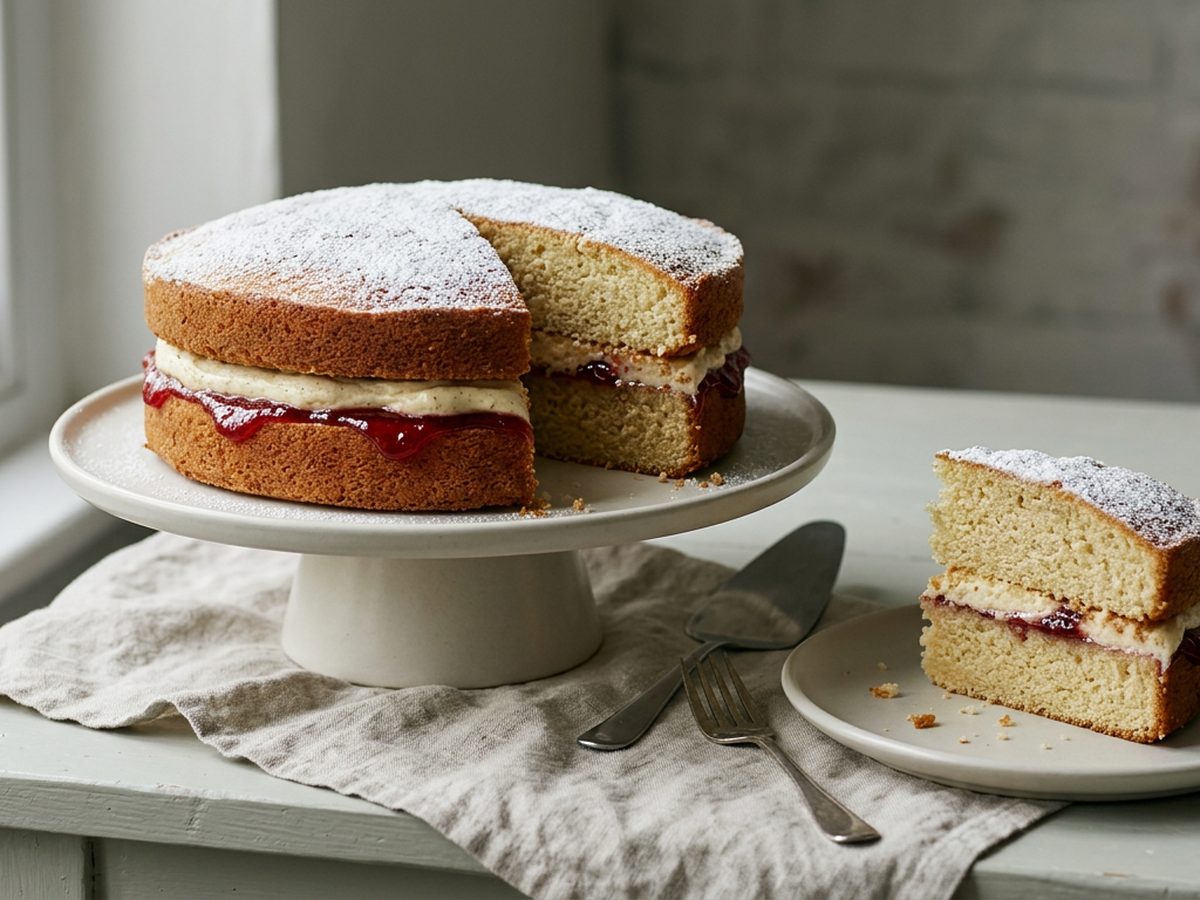
Two golden sponges, jam and buttercream. Exactly what a cake at a tea party should be.
- Hands-on
- 30 min
- Hands-off
- 1 h 10 min
- Total
- 1 h 40 min
- Makes
- 8 slices (8 to 10)
- Serves
- 8
Total = 30 min active (15 min mixing and filling the tins, about 15 min for the buttercream and assembly) + 70 min hands-off (25 min baking, 5 min in the tins, about 40 min cooling). Preheating overlaps the prep. The cooling time is our estimate; the cakes just need to be completely cold before you fill them.
Oven 180 °C · 160 °C fan (350 °F)
Pan 2 x 20 cm round sandwich tins (US: 2 x 8 in round cake pans)
- easy
- vegetarian
- afternoon-tea
- party
- british-classic
- baking-basics
Verified against at least two trusted test kitchens or food-safety guides · Last checked · What this means
Scaling? Made for two 20 cm (8 in) sandwich tins. Other tin sizes change the depth of the sponges and the baking time, so go by the doneness cues. Some items (like eggs) don’t halve neatly: beat them, then measure out half.
Ingredients
You need: two 20 cm (8 in) round sandwich tins · baking parchment · large mixing bowl · electric mixer · spatula · skewer · palette knife or round-bladed knife · clean tea towel · wire rack · oven mitts
Contains: wheat · egg · milk
Method
Heat the oven, prep the tins
Heat the oven to 180°C (160°C fan, 350°F, gas 4). Grease both 20 cm (8 in) tins and line the base of each with a circle of baking parchment.
Ready when: The oven has fully reached temperature (the preheat light is off, or an oven thermometer agrees) before the tins go in.
Make the batter in one bowl
Put the 4 eggs, 225 g caster sugar, 225 g self-raising flour, 1 level tsp baking powder and 225 g soft butter in a large bowl. Beat just until everything is combined and stop there. The batter should drop softly off the spoon.
Fill the tins
Divide the batter evenly between the two tins (weigh them if you want matching layers), scrape the bowl clean and smooth the tops.
Bake
Bake on the middle shelf for 25 minutes. Keep the door shut; look through the glass after 20 minutes instead.
Ready when: Golden, shrinking away from the sides of the tins, springy when pressed gently, and a skewer in the centre comes out clean.
Otto tried this firstOtto opens the oven every few minutes 'to check on them' and the sponges sink. Look through the glass instead.Cool
Leave the sponges in the tins for 5 minutes, then loosen the edges with a palette knife. Lay a clean tea towel over a tin, put your hand on top and flip it so the cake drops onto the towel, then move it to a wire rack. Repeat, and let both cool completely.
Make the buttercream
Beat the 100 g butter until soft. Add half of the 200 g sifted icing sugar and beat until smooth, then add the rest with 1 tbsp milk and beat until creamy. Add the second tbsp of milk only if it's too thick to spread.
Assemble
Pick the sponge with the nicer top for the lid. Put the other one top-side down on a plate, spread it with the 3 tbsp jam, then spread or pipe the buttercream over the jam. Set the second sponge on top, top-side up.
Otto tried this firstOtto fills the sponges while they're still warm and the buttercream slides out the sides. Wait until they are completely cold.Finish
Sprinkle the top with a little caster sugar and serve.
Swaps
- Instead of caster sugar on top: a dusting of icing sugar Both are traditional finishes.
- Instead of buttercream: whipped cream with the jam, plus sliced fresh strawberries if you like An alternative filling to buttercream.
Make ahead, store & reheat
- Make ahead
- The buttercream can be made ahead and kept in an airtight container in the fridge for up to about a week. Let it come to room temperature and beat it again before using.
- Storage
- This buttercream is all butter, so keep the filled cake in the fridge rather than out on the counter.
If something goes wrong
- Sponges sank in the middle Why: The oven door was opened too early.
Keep the door shut until at least 20 minutes and check through the glass. - Domed sponge Why: It rose more in the centre.
Slice the dome off the bottom layer with a bread knife, using slow, level strokes, so the filling sits flat. - Wire-rack lines on top Why: The cake was flipped straight onto the rack.
Turn it out onto a tea towel on your hand first, then move it to the rack.
Good to know
- Stop mixing as soon as the batter is combined.
- Weighing the filled tins is the easiest way to get two even layers.
- Room-temperature eggs mix in more easily.
Safety
- Don't taste the raw batter: raw flour and raw egg can carry harmful bacteria such as E. coli and Salmonella. Only the baked sponge is safe.
- After handling flour and raw egg, wash hands, bowls, utensils and the counter with warm soapy water, and keep raw batter away from ready-to-eat food.
- Tins and oven racks stay very hot for a while. Use oven mitts, and kids should only move things in and out of the oven with an adult.