Mains · British
Roast Pork with Crackling
Dry skin, a blast of heat, then patience. That's the crunch.
- Hands-on
- 20 min
- Hands-off
- 3 h 35 min
- Oven preheat
- 15 min
- Total
- 3 h 55 min
- Makes
- 1 roast (2-2.5 kg)
Includes 1 hour of uncovered fridge-drying; drying overnight gives a crisper rind but adds hours. Roasting is 40-50 min hot plus 30-35 min per kg; the figures here are for a 2.5 kg joint. Preheat minutes are our estimate.
Oven 240 °C · 220 °C fan (475 °F)
Pan shallow roasting pan with a wire rack (US: shallow roasting pan with a wire rack)
- medium
- gluten-free
- dairy-free
- sunday-roast
- christmas
- roast
- crackling
Verified against at least two trusted test kitchens or food-safety guides · Last checked · What this means
Scaling? Scale by weight, not servings: after the hot start, roast 30-35 minutes per kg at 180°C (about 14-16 minutes per lb), then let the thermometer decide. Some items (like eggs) don’t halve neatly: beat them, then measure out half.
Ingredients
You need: sharp knife · paper towels · plate or tray for the fridge · wire rack · shallow roasting pan · meat thermometer · two oven mitts · cutting board
Contains: none of the 9 major allergens in the listed ingredients
Method
Score the rind
If the butcher hasn't done it, score the rind in thin, even lines with a sharp knife, going through the skin and fat but not into the meat. Weigh the joint so you can work out the roasting time.
Otto tried this firstOtto saws so deep that he cuts into the meat. The lines should stop at the fat; the meat stays whole.Dry it in the fridge
Pat the rind dry with paper towels. Leave the pork uncovered on a plate in the fridge for at least 1 hour, or overnight if you can.
Heat the oven
Heat the oven to 240°C (220°C fan, gas 9, 475°F).
Ready when: The oven has fully reached 240°C (475°F); give it the full preheat.
Oil and salt the rind
Pat the rind dry once more, then rub a little oil and a generous pinch of flaky salt into the score lines.
Blast for crackling
Set the pork on a rack in a shallow roasting pan and roast for 40-50 minutes. Keep the oven door shut the whole time.
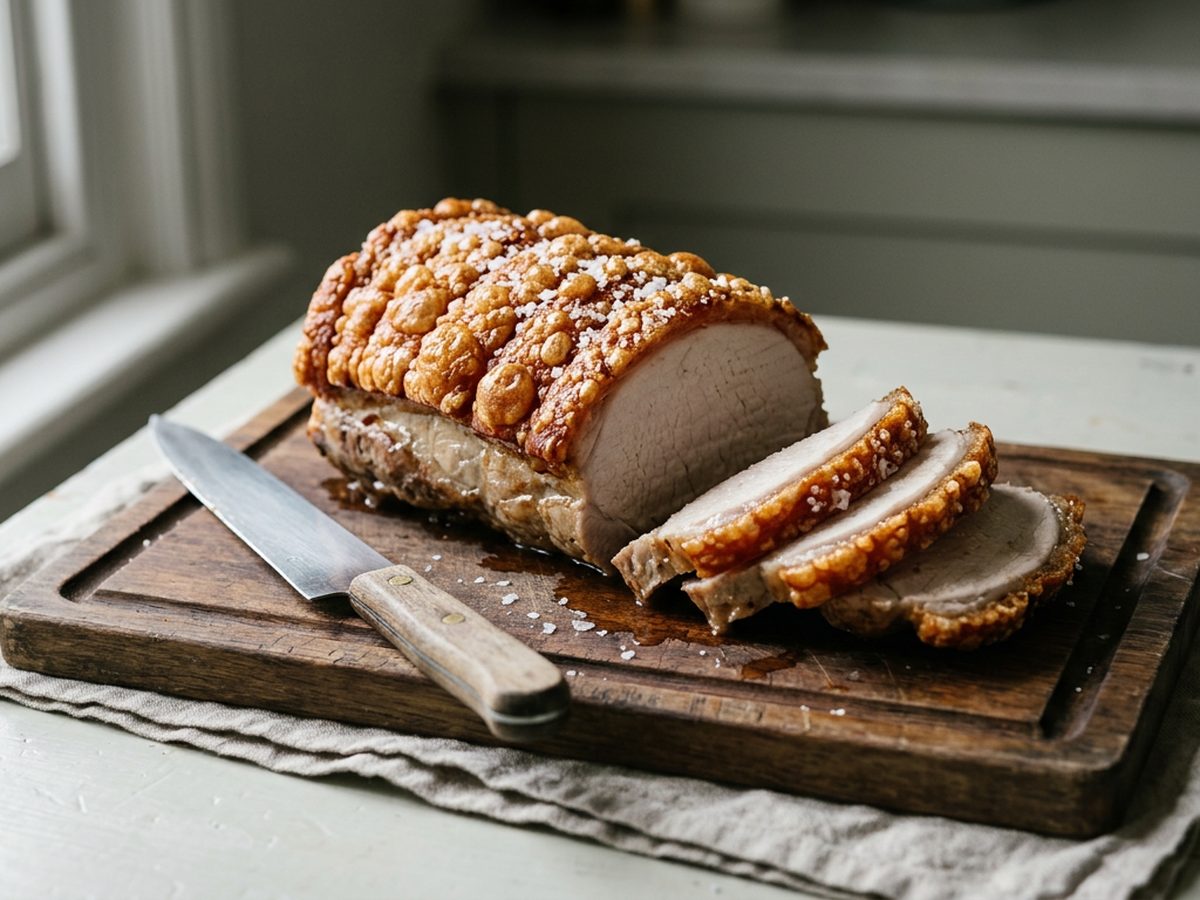
Ready when: The rind is golden, puffed and bubbly all over.
Otto tried this firstOtto keeps opening the door to 'check on the crackling' and lets the heat out. The door stays shut for this stage.Lower the heat and cook through
Turn the oven down to 180°C (160°C fan, gas 4, 350°F) and roast for 30-35 minutes per kg (about 14-16 minutes per lb), which is 60-90 minutes for a 2-2.5 kg joint.
Ready when: Pork must be cooked all the way through. Pierce the thickest part: the juices run clear and there's no pink meat, and a thermometer in the centre of the thickest part reads at least 75°C (167°F). If it's lower, roast 10 minutes more and check again.
Rest, then carve
Move the pork to a board and rest it for 10-20 minutes. Lift off the crackling, snap it into pieces, then slice the meat.
Swaps
- Instead of plain salt on the rind: salt mixed with a little chilli powder or fennel a well-known variation
Make ahead, store & reheat
- Make ahead
- Score the rind and leave the joint uncovered in the fridge overnight. This is the best head start for crisp crackling.
- Storage
- Cool leftovers and put them in the fridge within 1 to 2 hours. Eat them within 2 days or freeze them.
- Reheat
- Reheat until steaming hot all the way through.
If something goes wrong
- The crackling is still soft or chewy when the meat is done
Put the pork on a tray in the middle of the oven under the grill (broiler) at 200°C for 4-5 minutes. Watch it the whole time, turn it if needed, then rest it for 4-5 minutes. Chewy crackling usually means fat or moisture was left under the skin. - Some patches are burning before the rest has crackled
Cover only the dark patches with small pieces of foil while the rest catches up. - The rind steamed and went leathery instead of crisp
Water on the surface stops the skin getting hot enough. Next time pat it very dry and give it time uncovered in the fridge.
Good to know
- A dry rind matters more than anything else. Paper towels first, then fridge time uncovered.
- The two oven stages do different jobs: the hot start puffs the crackling and the lower heat cooks the meat through.
Safety
- Pork has to be cooked all the way through: clear juices, no pink, and at least 75°C (167°F) in the centre. That's the stricter of the two official food-safety rules (the other is 63°C / 145°F plus a 3-minute rest for whole cuts); we use the stricter one.
- Raw pork: use its own board, keep it away from ready-to-eat food, and wash hands and surfaces with hot soapy water afterwards.
- Scoring tough rind makes knives slip. Only grown-ups do this, cutting away from the hand that holds the joint.
- At 240°C, fat spits when the door opens. Wear oven mitts, keep your face back, and keep kids away from the open oven.