Sweets · Italian
Panna Cotta
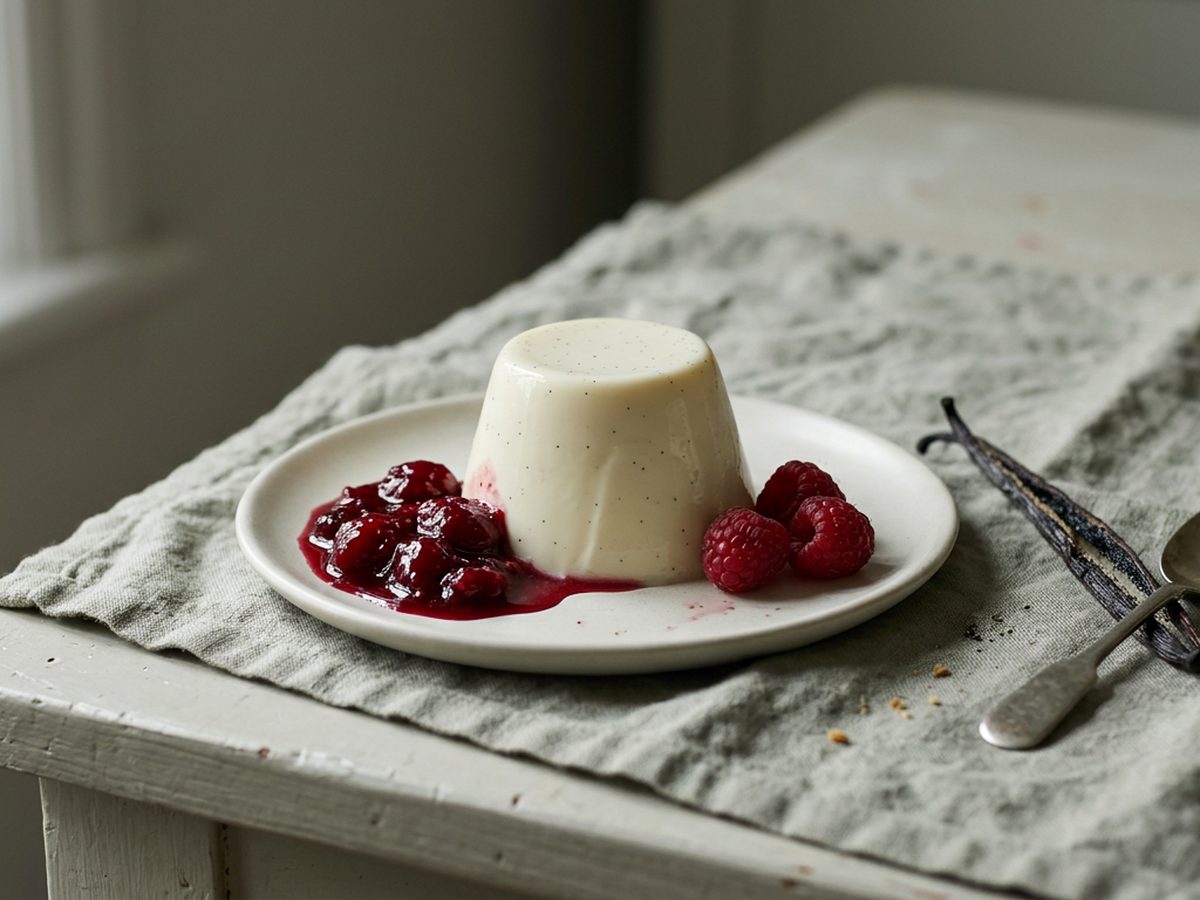
Warm vanilla cream set with a little gelatine, just firm enough to stand up and wobble on the plate.
- Hands-on
- 20 min
- Hands-off
- 3 h 30 min
- Total
- 3 h 50 min
- Makes
- 4 panna cottas (about 125 ml / 1/2 cup each)
- Serves
- 4
Passive time is about 30 minutes of cooling (our estimate; the source says to cool to room temperature) plus at least 3 hours in the fridge. Overnight is fine.
- medium
- gluten-free
- make-ahead
- date-night
- no-bake
- holiday
Verified against at least two trusted test kitchens or food-safety guides · Last checked · What this means
Scaling? Gelatine leaves vary in strength between brands, so if you change brand, check the pack for how much liquid one leaf sets. Doubling is straightforward; cooling a bigger batch takes longer. Some items (like eggs) don’t halve neatly: beat them, then measure out half.
Ingredients
You need: small bowl of cold water · medium saucepan · fine sieve · jug · 4 moulds, ramekins or glasses, about 125 ml (4 fl oz) each · plates for turning out
Contains: milk
Method
Soak the gelatine
Put the 2 gelatine leaves in a bowl of cold water and leave them for 5 to 10 minutes.
Warm the cream gently
Put the 300 ml (1 1/4 cups) cream, 200 ml (6 3/4 fl oz) milk and 60 g (5 tbsp) sugar in a saucepan. Scrape the seeds from the split vanilla pod into the pan and drop the pod in too. Warm over low heat, stirring, until the sugar has dissolved.
Ready when: The cream is hot and steaming, with no sugar grains left on the spoon, but it is not bubbling. Do not let it boil.
Otto tried this firstOtto walks off and lets the pan boil over. The sources warm the cream gently and keep it below a boil.Dissolve the gelatine
Take the pan off the heat. Lift the soft gelatine leaves out of the water, squeeze them gently and stir them into the hot cream.
Ready when: Stir until you can't see any clear strands of gelatine. The cream should look smooth.
Strain and cool
Pour the cream through a fine sieve into a jug to catch the pod and any undissolved bits. Leave it to cool to room temperature, stirring every few minutes so the vanilla seeds stay mixed in.
Ready when: The jug feels only barely warm to the touch.
Fill and chill
Stir once more, then divide the cream among the 4 moulds. Chill for at least 3 hours.
Ready when: Set but still soft: a gentle wobble when you nudge the mould. It should be firm enough to stand on its own once turned out.
Turn out
Dip each mould in warm water for a few seconds, then turn it upside down onto a plate and lift the mould away. Or serve it in the glass.
Otto tried this firstOtto shakes the mould hard and the panna cotta breaks. A few seconds in warm water loosens it.
Make ahead, store & reheat
- Make ahead
- Panna cotta can be made the day before you serve it. Keep it covered in the fridge.
- Storage
- Keep it covered in the fridge and don't leave it out for more than 2 hours. The sources give no limit beyond making it a day ahead, so we don't either.
If something goes wrong
- It won't come out of the mould Why: The cream is still stuck to the sides.
Dip the mould in warm water for a few more seconds and try again. - All the vanilla seeds sank to the bottom Why: The cream was poured before it was stirred.
Stir every few minutes while it cools and once more just before filling the moulds. - Little rubbery lumps Why: Some gelatine didn't fully dissolve.
Stir it into hot cream off the heat until it disappears, then strain through a fine sieve.
Good to know
- The goal is 'only just set': soft enough to wobble but firm enough to stand up once turned out.
- To unmould, dip the ramekins about three-quarters of the way into warm water.
- Serve with fresh berries, such as sliced strawberries with a little mint.
Safety
- Hot cream can scald. Keep the pan handle turned in, and let kids help with the chilled steps, not the stove.
- Gelatine is made from animal collagen, so this is not vegetarian.
- It's a dairy dessert: keep it in the fridge and don't leave it out for more than 2 hours (1 hour if it's above 32°C / 90°F).