Sides · French
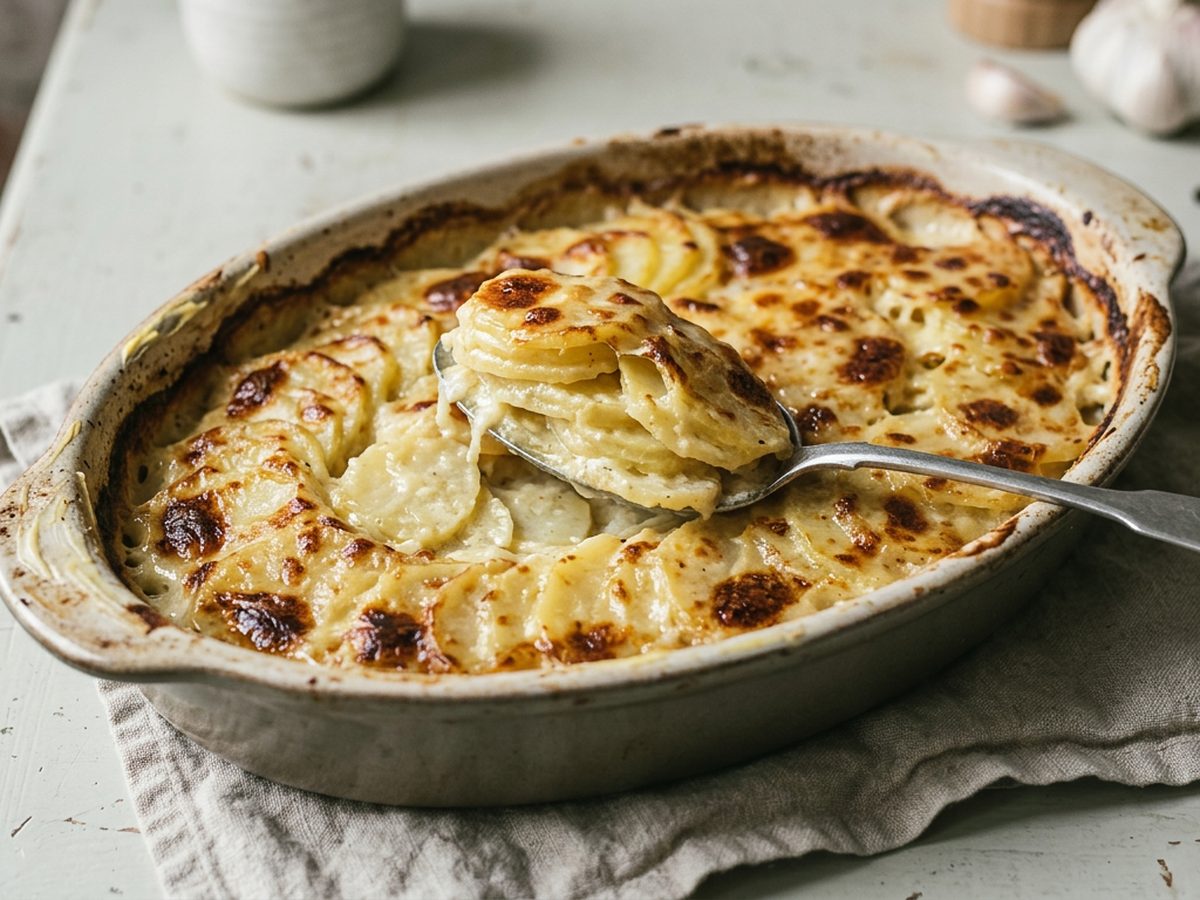
Gratin Dauphinois
Thin potato slices, garlicky milk and cream, one slow bake. No cheese required.
- Hands-on
- 30 min
- Hands-off
- 1 h 25 min
- Total
- 1 h 55 min
- Makes
- 6 servings (6-8)
- Serves
- 6
Prep (peeling and slicing) is our estimate; the oven heats while you do it. Cook is about 10 min on the stove plus 1 hour in the oven. Passive is the 20-30 min rest before serving. Total = 30 min active + 85 min hands-off (1 hour baking, 20-30 min rest).
Oven 190 °C · 170 °C fan (375 °F)
Pan 1.4 L (6-cup) gratin dish (US: 6-cup gratin dish)
- easy
- vegetarian
- gluten-free
- holiday
- side-dish
- french-classic
- potatoes
Verified against at least two trusted test kitchens or food-safety guides · Last checked · What this means
Scaling? Made for a 6-cup (about 1.4 L) gratin dish. If you double it, use a pan big enough to keep the same depth or a second dish; a deeper layer needs longer in the oven, so go by the fork test, not the clock. Some items (like eggs) don’t halve neatly: beat them, then measure out half.
Ingredients
You need: 6-cup (about 1.4 L) gratin or baking dish · vegetable peeler · sharp knife or mandoline with its hand guard · large saucepan · wooden spoon or heatproof spatula · baking sheet · fork for testing · oven mitts
Contains: milk
Method
Heat the oven, butter the dish
Heat the oven to 190°C (170°C fan, 375°F). Rub about 1 tsp soft butter over the inside of the 1.4 L (6-cup) gratin dish.
Peel and slice
Peel the 800 g (1 3/4 lb) potatoes and slice them 3 mm (1/8 in) thick. Do NOT rinse the slices: their starch is what thickens the sauce.
Otto tried this firstOtto gives the slices a nice long rinse 'to be clean'. Rinsing washes away the starch that thickens the milk, so his gratin would come out thin. He peels a fresh batch and leaves the slices alone.Bring to the boil on the stove
Put the slices in a large saucepan with 600 ml (2 1/2 cups) milk, the chopped garlic, 3/4 tsp salt and 1/2 tsp pepper. Bring to a boil over medium heat, stirring gently and scraping the bottom so the slices separate and nothing sticks. Let it bubble for about 1 minute.
Ready when: The milk has come to a full boil and turned thick and creamy around the slices. The potatoes are still firm; they finish in the oven.
Into the dish, add the cream
Pour the hot potato mixture into the buttered dish and spread it level. Pour 240 ml (1 cup) cream evenly over the top.
Bake
Set the dish on a baking sheet to catch drips and bake for about 1 hour.
Ready when: Most of the liquid has been absorbed, a fork slides easily into the potatoes in the middle, and the top is golden brown and glazed. If the fork meets resistance, bake a little longer and test again.
Rest before serving
Let the gratin rest for 20 to 30 minutes. It is too hot and runny to serve straight from the oven, and it firms up as it stands.
Swaps
- Instead of Yukon Gold potatoes: boiling potatoes such as Red Bliss Boiling potatoes work; Yukon Gold is the first choice.
- Instead of no cheese (classic): a little grated Gruyère scattered on top before baking A traditional family touch; strictly speaking, with cheese it becomes a gratin savoyard.
Don’t swap
- Rinsed or soaked slices for unrinsed ones: the starch thickens the sauce
Make ahead, store & reheat
- Make ahead
- Peel the whole potatoes the day before and keep them in the fridge completely covered with cold water so they don't discolour; slice them just before cooking. If dinner runs late, keep the baked gratin uncovered in a 71-77°C (160-170°F) oven.
- Storage
- Refrigerate leftovers within 2 hours and use them within 3 to 4 days. Leftovers are good cool or at room temperature the next day; take them out of the fridge only for as long as you're eating.
- Reheat
- Reheat leftovers until hot all the way through, to at least 74°C (165°F).
If something goes wrong
- Thin, watery sauce Why: The slices were rinsed or soaked, washing away their starch.
Leave the cut slices unrinsed and bring them to the boil in the milk, which thickens it. - Potatoes still firm after an hour Why: Slices cut thicker than 3 mm, or a deeper dish.
Keep baking until a fork slides in easily, and slice to 3 mm (1/8 in) next time. - Sauce looks split or oily Why: All-cream mixtures split more easily.
Keep the milk-and-cream mix as written; mixing milk with cream lowers the chance of splitting.
Good to know
- Set the dish on a baking sheet: the bubbling cream often spills over.
- For even cooking, slices should all be the same thickness. A mandoline helps; always use its hand guard.
- Serve it with a garlicky frisée or escarole salad, or alongside roast chicken or lamb.
Safety
- Mandoline blades are extremely sharp. Use the hand guard and stop when the potato gets small; kids should not use one.
- Boiling milk and potatoes can catch on the bottom and spit. Stir with a long spoon over medium heat and keep kids back from the stove.
- The dish comes out bubbling at 190°C (375°F) and stays very hot for a long time. Use oven mitts and let it rest before serving.
- Milk-and-cream dishes need the fridge: don't leave leftovers out for more than 2 hours.