Breakfast · French
Crepes
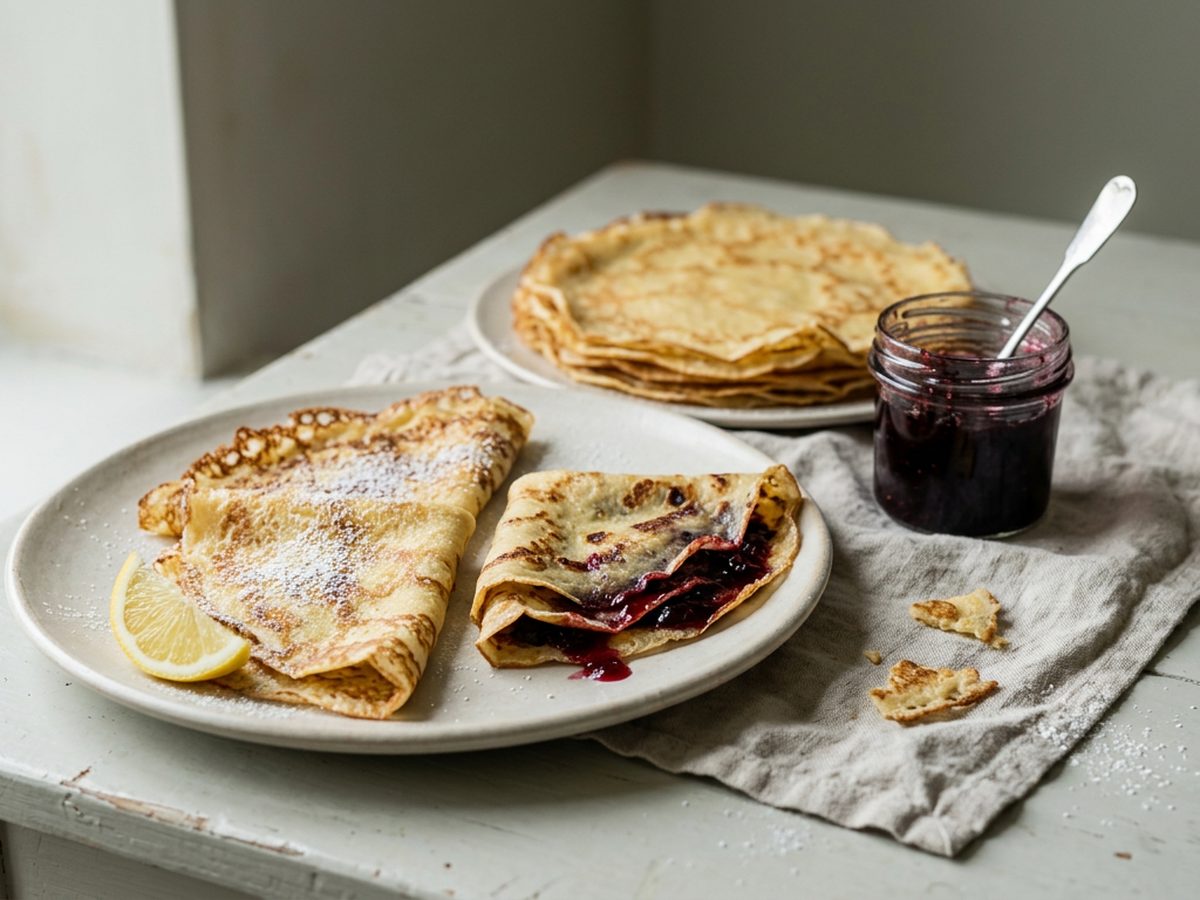
Paper-thin, a little lacy, and happy to hold jam, lemon and sugar, or ham and cheese.
- Hands-on
- 25 min
- Hands-off
- 1 h
- Total
- 1 h 25 min
- Makes
- 18 crepes (about 17-22, 20 cm / 8 in)
Pan 20 cm non-stick frying pan (US: 8 in non-stick skillet)
- medium
- vegetarian
- breakfast
- brunch
- make-ahead
- freezer-friendly
- sweet-or-savory
Verified against at least two trusted test kitchens or food-safety guides · Last checked · What this means
Scaling? The batter scales up or down evenly. Cooking time grows with the number of crepes because you cook them one at a time. A bigger pan needs more batter per crepe: about a scant 1/3 cup in a 25 cm (10 in) pan. Some items (like eggs) don’t halve neatly: beat them, then measure out half.
Ingredients
You need: blender · 20 cm (8 in) non-stick frying pan · thin heatproof spatula · 2-tablespoon (30 ml) measure or small ladle · plate or cutting board · plastic wrap or parchment for stacking
Contains: egg · milk · wheat
Method
Blend the batter
Put 2 eggs, 180 ml (3/4 cup) milk, 120 ml (1/2 cup) water, 120 g (1 cup) flour and 42 g (3 tbsp) melted butter in a blender. Pulse for about 10 seconds, just until smooth.
Rest it in the fridge
Cover the blender jug and refrigerate the batter for 1 hour.
Otto tried this firstOtto skips the rest and his first crepe tears in half on the flip. The hour lets the bubbles settle, which makes crepes less likely to tear.Heat the pan
Set the pan over medium heat and add a small piece of butter, swirling it to coat the base.
Ready when: Butter melted and gently bubbling, not browning or smoking.
Pour and swirl
Pour 30 ml (2 tbsp) of batter into the middle of the pan, then straight away tilt and turn the pan so the batter runs into a thin, even circle.
Ready when: The batter sets almost as soon as it touches the pan, into a thin, even layer.
Cook the first side
Leave it alone for about 30 seconds.
Ready when: The top looks dry and matte, the underside is lightly browned, and a thin spatula slides under the crepe easily.
Flip and finish
Flip the crepe and cook the second side for about 10 seconds, then slide it flat onto a plate.
Ready when: Second side set, with a few light-brown spots.
Repeat
Cook the rest of the batter the same way, adding a little more butter to the pan when it looks dry. Stack the finished crepes with plastic wrap or parchment between them.
Ready when: Each crepe gets the same check: lightly browned underneath and easy to lift before you flip.
Fill and serve
Spread a thin layer of filling over a warm crepe and roll it up or fold it into quarters.
Make ahead, store & reheat
- Make ahead
- The batter keeps up to 48 hours in the fridge. Cooked crepes can be made ahead too: see storage.
- Storage
- Let the crepes cool, stack them with plastic wrap between, and seal them in a bag. Refrigerate within 2 hours and use within 3-4 days (some recipes just say 'several days', so we use the more cautious food-safety guideline). Freeze unfilled crepes for up to 2 months, then thaw them on a rack and peel them apart gently.
If something goes wrong
- Crepes tear when you flip them
Rest the batter the full hour, and wait until the underside is lightly browned and the spatula slides under easily before flipping. - Crepes come out thick, like pancakes
Use less batter (about 30 ml in a 20 cm pan) and tilt the pan the moment the batter goes in.
Good to know
- Savory batter: add 1/4 tsp salt and 1/4 cup chopped fresh herbs, spinach or sun-dried tomatoes to the blender.
- Sweeter batter: add 2 1/2 tbsp sugar and 1 tsp vanilla.
- Keep the finished stack covered so the crepes stay soft.
Safety
- Don't taste the raw batter: raw flour and raw egg can carry bacteria such as E. coli and Salmonella. Only cooked crepes are safe to eat.
- Wash your hands, the blender and the counter with warm, soapy water after handling raw batter.
- The pan and melted butter are hot. Flipping needs a steady hand, so kids should do it with an adult beside them, using a spatula, never their fingers.
- Keep the batter in the fridge while it rests. Raw egg and milk shouldn't sit out at room temperature.