Soups · Ukrainian
Borscht
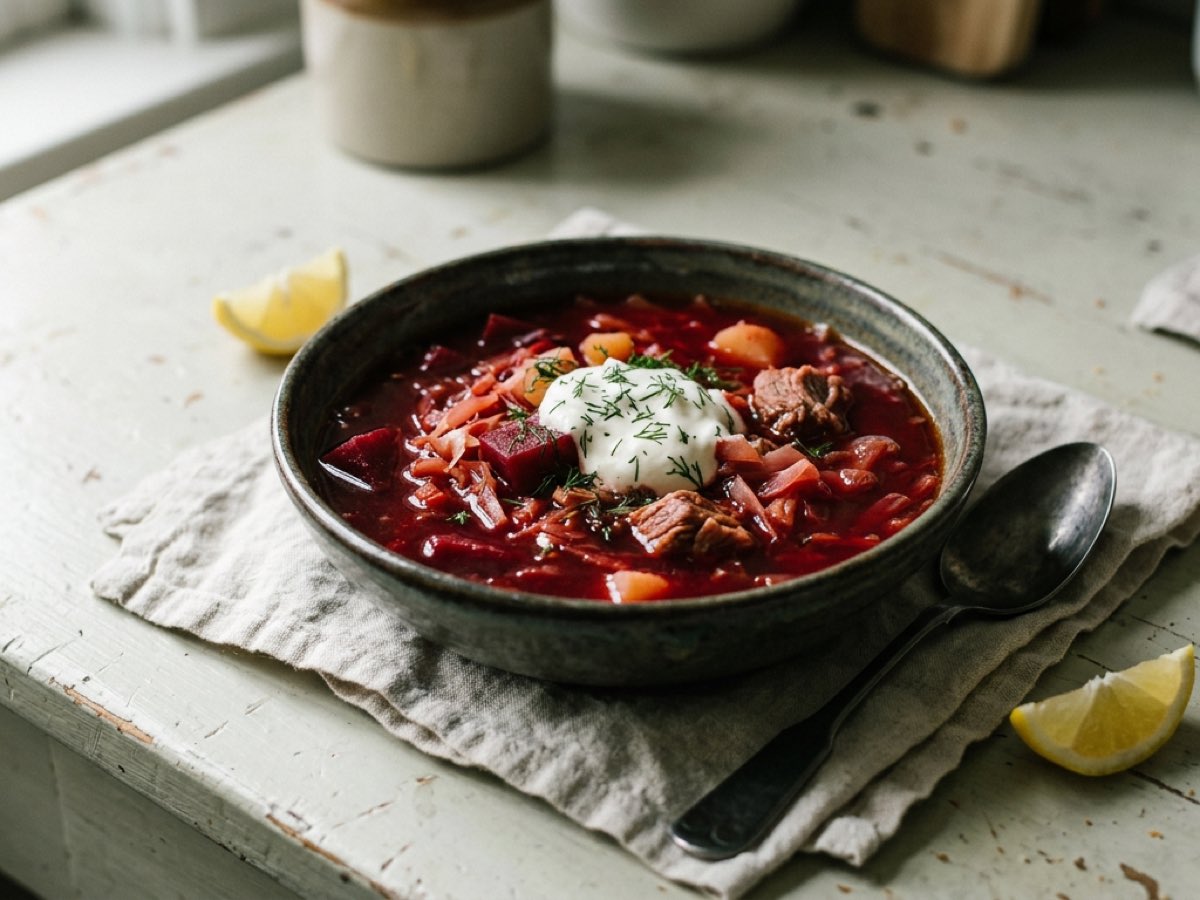
A ruby-red pot of beets, cabbage and tender pork, brightened with dill and lemon.
- Hands-on
- 55 min
- Hands-off
- 2 h 30 min
- Total
- 3 h 25 min
- Makes
- 8 bowls
- Serves
- 8
Hands-off: about 15 min for the broth to come to a boil, 2 hours of covered simmering, and about 15 min for the pork to cool enough to cut. Peel and shred the vegetables while the broth simmers (about 20 min), so that time isn't counted twice. Total = 55 min active + 150 min hands-off. Published versions list up to 3 3/4 hours; the soup also tastes better made a few hours or a day ahead.
- medium
- winter
- make-ahead
- freezer-friendly
- one-pot
Verified against at least two trusted test kitchens or food-safety guides · Last checked · What this means
Scaling? Serves 6 to 8 from one large Dutch oven (about 7 litres / 7 quarts). To halve, use a smaller pot; simmer times stay about the same. Don't double in the same pot. Some items (like eggs) don’t halve neatly: beat them, then measure out half.
Ingredients
You need: large Dutch oven or heavy soup pot (about 7 litres / 7 quarts) with lid · 30 cm (12 in) skillet · box grater · ladle and slotted spoon · large spoon for skimming · two forks or a knife and board for the pork
Contains: milk
Method
Start the broth
Put the 900 g (2 lb) pork, halved onion, sliced carrot, 2 bay leaves, 1/2 tsp salt and 2.4 litres (10 cups) water in the Dutch oven. Bring to a boil over high heat.
Ready when: Big bubbles break across the whole surface.
Simmer until tender
Turn the heat down so it just simmers, cover and cook about 2 hours, skimming off the foam from time to time. Peel and shred the beets and carrots and slice the cabbage while you wait.
Ready when: The pork is fork-tender and pulls apart easily, far past the 63°C (145°F) food-safety minimum for pork.
Cut the pork, skim the broth
Lift the pork onto a board and throw out the onion, carrot and bay leaves. When the pork is cool enough to handle, cut it into bite-size pieces (it's fine if it shreds). Spoon the fat off the broth.
Potatoes and cabbage
Scoop out 120 ml (1/2 cup) of broth and set it aside. Bring the rest back to a boil over high heat, add the 450 g (1 lb) potatoes, the cabbage and 1/2 tsp salt, then cover and keep it at a gentle simmer for 8 to 10 minutes.
Ready when: A knife slides into the potato pieces with only slight resistance: just tender.
Otto tried this firstOtto pours all the broth into the pot and then has nothing to loosen the thick beet mixture in the skillet. Keep that 1/2 cup back first.Soften onion, beets and carrots
Meanwhile heat 60 ml (1/4 cup) oil in the skillet over medium heat. Cook the chopped onion, stirring often, about 5 minutes. Add the shredded beets, carrots and 1/2 tsp salt and cook, stirring often, 3 to 5 minutes.
Ready when: The oil shimmers before the onion goes in; the onion turns soft and see-through and the beets and carrots soften and wilt.
Toast the tomato paste
Stir in the 170 g (6 oz) tomato paste and cook 1 to 2 minutes, then slowly stir in the reserved 120 ml (1/2 cup) broth, scraping up the browned bits from the pan.
Ready when: The paste smells fragrant and turns a shade darker.
Bring it together
Gently stir the beet mixture into the pot, cover and simmer 5 minutes. Stir in the pork, 80 ml (1/3 cup) dill, 1 tbsp lemon juice and the last 1/2 tsp salt. Taste and add pepper or more lemon juice if you like.
Ready when: Steaming hot all the way through and deep red, with the potatoes soft.
Serve
Ladle into bowls and top with more dill, plus a spoonful of sour cream if you like.
Swaps
- Instead of lemon juice: red wine vinegar, added to taste at the end Either acid brightens the beets; add a little at a time.
- Instead of pork butt: pork ribs, browned first and simmered in the water to make the broth Ribs give a similar rich broth; cook until the meat is tender.
Make ahead, store & reheat
- Make ahead
- Borscht tastes better made at least a few hours ahead, or up to the day before, so the flavours blend. You can also make the broth a day early: cool it, refrigerate it overnight with the pork stored separately, and lift the hardened fat off the top before going on.
- Storage
- Cool quickly (divide into shallow containers), refrigerate within 2 hours and eat within 3 days. Freeze for up to 4 months.
- Reheat
- Reheat on the stove until steaming hot throughout, at least 74°C (165°F).
If something goes wrong
- Flat, earthy taste Why: Not enough acid or salt.
Add lemon juice (or a splash of vinegar) and salt a little at a time and taste again. - Greasy surface Why: Fat wasn't skimmed from the broth.
Skim before adding the vegetables, or chill the broth overnight and lift off the solid fat. - Beets still hard Why: Beets were cubed instead of shredded.
Shred them on a box grater; shredded beets soften in minutes and colour the soup quickly.
Good to know
- Prep all the vegetables during the 2-hour simmer.
- Shredding beets and carrots and softening them separately in the skillet keeps them tender and sweet.
- Serve with bread; sour cream is traditional but optional.
Safety
- Beet juice stains hands, boards and clothes. Wear an apron, and use gloves if you like.
- A big pot of soup is heavy and very hot. Lift it with both hands and oven mitts; kids should stay back from the stove while it boils.
- Hot oil in the skillet can spit when the wet vegetables go in. Add them gently.
- Leave out the sour cream to keep the bowl dairy-free; milk is listed only because of that topping.